Thursday, April 26, 2012

Sino-American Military Frictions


After the Taiwan-Strait crisis in 1995-1996, China accelerates to build up military forces; its air and navy forces have achieved remarkable expansion. Recently, the development of aircraft carriers, like the other significant military developments in China, once again attracts world’s attention, especially America’s vigilance. The potential threat posed by China’s military buildup can severely injure the U.S. interests in Asia-Pacific region.


 According to the U.S. Defense Department analysis, one of the significant goals of the PLA’s expansion is pursuing strategic interests beyond China’s territorial boundaries, to be specific, controlling the sea lanes to secure the access to oil and defending interests in South China Sea. Nowadays over 80 percent of China’s oil is transported from Africa and the Persian Gulf through sea lands. Thus, the sea lane which is from the South China Sea through the Strait Malacca, across India Ocean, to the Persian Gulf is a significant strategic interest to China. But the America’s naval activities in these seas which are also vital for American interests are challenging China.

China’s claims that it has the largest portion of territory in South China Sea - an area stretching hundreds of miles south and east from its most southerly province of Hainan lead to  hot dispute from Vietnam and the Philippines; these two countries also declare their sovereignty in South China Sea. China’s challenge in the South China Sea directly threatens America’s allies and freedom of the seas which is a non-negotiable interest of the United States. The U.S. is the world’s preeminent seafaring nation and half of global shipping and most of Northeast Asia’s energy supplies transit through South China Sea. At the same time, the America’s shared interests with Vietnam in safeguarding peace and security in the western Pacific and in balancing growing China’s regional clout are also challenged by China’s claims. Another crucial goal is to deter Taiwan from independence. China has deployed many advanced military systems towards Taiwan and had more than 1000 conventionally armed short-range ballistic missiles directly targeting Taiwan. According to an analysis conducted by AEI, China has already had the ability to complete an air war to Taiwan before the U.S. and Taiwan’s air forces fired a shot.

Territory of South China Sea that China claimed

The modernization and expansion of China’s military forces can weaken the U.S. and its allies’ defending capabilities. China has enough power projection to threaten the U.S. and allies’ defense deployment in the “first island chain” and “second island chain”. Besides, in terms of the strategic nuclear force, as Pentagon reported, China has improved its strategic missile force in quantity and quality which enhances China’s nuclear deterrence and strike ability.

China's Strategic "First Sea Chain" and "Second Sea Chain" to US

Based on the American interpretation of China’s military force buildup, the U.S. is trying to impede China from possessing military advantages in Asia-pacific region by developing the “Joint air-sea battle concept” which integrates all military domains to contain China’s military expansion. Moreover, the U.S. uses three “island chains”, from Japan to Diego Garcia, from Guam to Australia and from Hawaii to Alaska to weaken China’s nuclear projection.

America’s hard response and its "Back to Asia" actions alert China and influence China’s perspective of the current condition in Asia-Pacific region. In “National Defense White Paper 2010”, China explicated that the profound unfavorable modifications are taking forms in Asia-Pacific strategic landscape mainly due to America’s increasing reinforcement regional military alliances and involvement in Asia security affairs; considering its own interests, even though China is pursing to build mutual trust with the U.S, it will continue to build up the military force. Such concern will be the biggest barrier for building mutual trust. Two governments has been promoting senior level military dialogues and meetings between China and the United States and achieved progress on some degree, but America’s army sales to Taiwan and other uncertain elements in military communications set a lot of challenges for both countries.


Even though Chinese military build-up could be a friction for Sino-American relationship, due to economic interdependency, the suspicion or conflicts on military area will not become hot wars or serious confrontations. They would try to deal with disputes through mutually respectful dialogue and cooperation as what they are doing now.

Thursday, April 19, 2012

Leadership Transition in China

Leadership transition this year probably will be the most immediate and obvious political change in China. This leadership transition will bring trivial, if any, but the most immediate impacts to Chinese-American relations. The Chinese Communist Party will form the fifth generation of leaders in 2012 centered on Xi Jinping if everything goes as expected.

In China’s next leadership transition, which has taken place mainly at the 18th Party Congress in 2012, it seems highly certain that Xi Jinping and Li Keqiang will take the leading positions. Xi will be appointed General Secretary of the Chinese Communist Party, and Li will be the Premier (at the National People’s Congress of March 2013).

Xi Jinping (Left) and Li Keqiang

Xi is a very market-friendly person and he worked as a provincial chief or municipal boss in three places in China, namely, Fujian, Zhejiang, and Shanghai, all the economic-rich and the market well-developed areas. During his tenure in these three provinces, he always worked very well with private sectors, with entrepreneurs, whether foreign companies or joint ventures. Li was accepted into the newly reopened law department of the elite Peking University in 1978, after its closure in the Cultural Revolution. During his time there he was heavily influenced by liberal professors who advocated democracy and constitutionalism. Li also joined a team that translated Lord Denning’s Due Process of Law.He is regarded as something of a liberal although, if he has a personal vision beyond current policies, he keeps it carefully hidden from the public. Among the engineer-heavy leadership, Li stands out with a doctorate of economics from Peking University.


Although it is not clear who are going to fill the other seven spots in the Politburo Standing Committee of the CPC Central Committee, which is the actual power organ of China, one thing seems pretty clear: the fifth generation of leaders in China are economy-oriented, which means the increasingly intertwined Sino-American economic relations will be likely to continue to deepen. It then determines the Sino-American status quo in terms of China’s domestic politics and human rights will not be challenged a lot despite the leadership transition, especially given the fact that the Sino-American relations have become increasingly institutionalized.


Regardless of whether Obama is re-elected president in 2012 for another four years or a Republican candidate comes to power, the core elements of U.S. policy toward China is likely to remain the same because prioritizing economic and security cooperation continues to serve U.S. interests.

Thursday, April 12, 2012

RMB Appreciation and US Debt

Economic interaction has a super vital impact on Sino-American relations considering the fact that the U.S. administration officials and their Chinese counterparts presided over an ever-increasing economic interdependency between the United States and China. They both need each other to recover from ongoing global financial crisis and they still have unsettled and potential economic conflicts. 

As the United States’ largest creditor and import country, second largest trade partner, third largest export market, China had an important influence on buffering negative impacts of the global economic recession and increasing job opportunities in the U.S. When President Hu Jintao paid the state visit to the U.S. in January this year, China announced a series of commercial deals to purchase USD 45 billion in the U.S. exports, supporting 235,000 jobs in the United States. China in turn has been influenced in important ways by America’s leading economy, source of foreign investment and technology. As the China’s largest export country, the U.S. is playing an irreplaceable role in boosting economic development in China considering the fact that foreign trade accounts for 49.34% of China’s GDP in 2010.


According to Pew Research Center, 47% of Americans think China is the leading economic power while only 31% think America is 

However, these two countries’ economic relations are not that smooth in recent years. More recent U.S. initiatives and complains reflect a wide range of U.S. interests and constituencies concerned with RMB undervaluation.  Criticism in the United States over China’s currency policy emerged in recent years against the background of the massive and growing U.S. trade deficit with China, USD 273 billion in 2010, and complaints from U.S manufacturing firms and workers over competitive challenges by Chinese imports. Facing the international pressure led by the U.S, RMB has been allowed to floating a narrow margin around a fixed based rate, determined with reference to a basket of world currencies since 2005. Even though RMB has appreciated cumulatively by 6.7% since June 2010 when RMB was unpegged to US dollar, groups of senators in September still announced that they would pursue legislation requiring the Obama administration to push harder for China to allow RMB to further appreciate in a quicker pace. As a response, China’s government called on the U.S. to self-examine its severe economic problems and claimed that blaming “undervalued” RMB exchange rate is not an effective way to reduce trade deficit and increase job opportunities.


The Chinese administration also eschews major initiatives that have the potential to disrupt existing economic relationships seen as largely beneficial for Chinese interests. As America’s largest creditor with 1.17 trillion in Treasury Securities as of February 2012, China has significant national economic interests in the stability of the U.S. dollars and in the United States meeting its paying obligations. Debt crisis in the U.S. facilitated China initially to criticize American government “irresponsible” and “immoral” of untangling the crisis through the wrangling among Republicans and Democrats. Standard& Poor’s stripping the U.S. of its triple A credit rating for the first time further alerted China. It demanded the U.S. address its structural debt problems and ensure the safety of the U.S debt China holds.  


China's response to US Debt Crisis

What are the implications for Sino-US economic relations in terms of RMB appreciation and debt crisis? These two conflicts matter valuation of RMB and both countries’ domestic economic health. Even though RMB has unpegged to US dollars, China carefully manages its currency to closely track the value of the U.S. dollar. Any major disruption in the stability of the dollar will therefore have powerful implications for the stability of the RMB and has potential complications for both countries’ economic health. Overwhelming RMB appreciation or a crisis in the value of the dollar due to debt crisis could directly spur inflation or a disruption in China’s export machine. Despite Chinese long-term planning to move toward an economic model of domestic consumption, exports to the United States are still a significant driver of economic growth in China. So if these conflicts not dealt very well would directly impact U.S. consumer confidence and spending ability, thus reducing demand for Chinese exports; and force tough inflationary decisions in Beijing about maintaining a link between the RMB and a plummeting dollar and thus decreasing the U.S. domestic demands; increase the risk to Beijing of maintaining its pole position as a global purchaser of international debt instruments, worsening global economy, including the U.S.

On the whole, the Sino-American economic relationship has had a positive effect on the relations between the two countries. Despite the increasing trade frictions and RMB dispute between the two countries, China and the U.S. have the least possibility to launch extensive “trade wars” at the expense of each other’s significant market and investment, especially during the global financial crisis. Both governments have declared many times that the current and potential economic conflicts can only be solved through negotiation and collaboration without harm to current economic interdependency.   

Friday, April 6, 2012

Strategic Conflicts-1970s to Present

Unexpected mass demonstrations centered in Beijing’s Tiananmen Square and other Chinese cities in 1989 represented the most serious challenge to China’s post-Mao leadership. The negative impact of the Tiananmen crackdown on the American approach to China was compounded by the unforeseen and dramatic collapse of communist regimes in the Soviet bloc and other areas, leading to the demise of the Soviet Union in 1991. These developments undermined the perceived need for the United States to cooperate pragmatically with China despite its brutal dictatorship on account of a U.S strategic need for international support against the Soviet Union. The soviet collapse also destroyed the strategic focus of American foreign policy during the Cold War. The ability of the U.S. president to use Cold War imperatives to override pluralistic U.S. domestic interests seeking to influence American interest groups focused on China’s authoritarian regime in strongly negative ways, endeavoring to push U.S. policy toward a harder line against China. Taken together, these circumstances generally placed the initiative in U.S-China relations with U.S. leaders and broader forces in the United States. Chinese leaders at first focused on maintaining internal stability as they maneuvered to sustain workable economic relations with the United States and while rebuffing major U.S. initiatives that infringed on Chinese internal political control or territorial and sovereignty issues.
Tiananmen Crackdown


The other conflicts are not as serious as the Tiananmen crackdown, but definitely heavily influenced Sino-American relations responded by strong remonstrance from China. The first turning point came with President Clinton’s advocacy in 1993 and then his withdrawal in 1994 of linkage between Chinese human rights practices and the granting of nondiscriminatory U.S. trade status to China. A second and more serious crisis resulted from Clinton’s decision in 1995 to allow the Taiwan president to visit the United States. In 1999 contentious negotiations over China’s entry into the WTO, Chinese mass demonstrations following the U.S. bombing of the Chinese embassy in Belgrade.


A pattern of dualism in U.S.-China relations has arisen as part of the positive equilibrium in this decade. The pattern involves constructive and cooperative engagement on the one hand and contingency planning or hedging on the other. It reflects the mix noted above of converging and completing interests and prevailing leadership suspicions and cooperation. Chinese and U.S. contingency planning and hedging against one another sometimes involves actions like the respective Chinese and U.S military buildups that are separate from and develop in tandem with the respective engagement policies the two leaderships pursue with each other. At the same time, dualism shows as each government has used engagement to build positive and cooperative ties while at the same time seeking to use these ties to build interdependencies and webs of actions that oppose its interests. The policies of engagement pursued by the United States and China toward one another are designed to tie down aggressive, assertive, or other negative policy tendencies of the other power through webs of interdependence in bilateral and multilateral relationships. The recent positive outcome in U.S.-China relations is based on an increasing convergence of these respective engagement policies.

So this is my last post regarding the overview of Sino-American relations from 1900s to present. From next week I will talk about the current issues on Sino-American relationship starting with one of the hottest topics-the valuation of Chinese currency Yuan.

Saturday, March 31, 2012

Strategic Cooperation-1970s to Present

This is probably the most fluctuating period for Sino-American relations. This bilateral relationship experienced ebbs and flows in these three decades.

In these three decades, we see three main periods of time when the United States and China cooperated strategically to meet their respective national interests in different international circumstances.

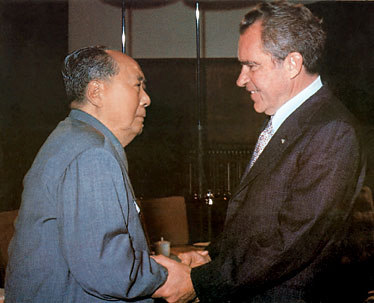
The first strategic cooperation was the opening of U.S.-China Relations due to geostrategic commonality to converge against the Soviet Union. The dramatic turnabout leading to the opening and then normalization in U.S.-China relations at the end of the 1960s and 1970s has been subject to concerns and assessments. The U.S. reconfigured the calculus of China’s position in world politics and its implications for the United States. This view highlights the importance of an apparent trend whereby U.S. leaders privately came to see China in the late 1960s as less threatening than in the past; eventually they came to view the Maoist regime as potential asset in American strategy focused increasingly on dealing with a rising and threatening Soviet Union. Despite these and other divergent views, assessments of this period and the opening in Sino-American relations find it hard not to give primacy to interpretations focused on the acute strategic necessities of both the United States and China amid circumstances of regional and international order featuring a rising and powerful Soviet Union challenging their core national interests. Similar concerns regarding national security as the U.S., the real danger of the Soviet Union military invading China, destroying its nuclear and other strategic installations, and forcing China to conform to Soviet interest moved Chinese leaders out of their self-initiated isolation.

The second strategic cooperation was in 1980s. The new U.S. leadership in 1980s shifted U.S. policy toward a less solicitous and accommodating stance toward China, while giving much higher priority to U.S. relations with Japan, as well as other U.S. allies and friends in East Asia. There was less emphasis on China’s strategic importance to the United States in American competition with the Soviet Union, and there was less concern among U.S. policy makers about China possibly downgrading relations over Taiwan and other disputes. This policy is seen to have added dimension related to a changing balance of forces affecting Chinese security and other interests in Asian and world affairs, which prompted heretofore demanding Chinese leaders to reduce pressures on the United States for concessions on Taiwan and other disputed issues. The Chinese leaders grudgingly adjusted to the new U.S stance, viewing their interests best served by less pressure and more positive initiatives to the Reagan administration, seen especially in their warm welcome for the U.S president on his visit to China in 1984. Cooperative Chinese relations with the United States were critically important to the Chinese leadership in maintaining Chinese security in the face of continuing pressure from the Soviet Union and in sustaining the flow of aid, investment, and trade essential to the economic development and modernization underway in China.

Reagan's visit to China in 1984
The pattern prevailing into the twenty-first century saw the U.S. administration and the Chinese administration generally continue to seek closer ties, including frequent high-level leadership meetings and various senior official dialogues, in order to develop areas of common ground while managing differences. Both administrations typically highlighted the many positive results from U.S.-China cooperation and dialogue. There have included cooperation in facilitating mutually advantageous trade and investment relations, cooperation in managing such regional crisis and threats as the Asian economic crisis of 1997-1998, the crisis in 1994 and again beginning in 2002 over North Korea’s nuclear weapons program, the global war on terrorism beginning in 2001 and the ongoing economic crisis. Under the rubric of engagement or cooperation, the U.S. administration officials and their Chinese counterparts presided over an ever-increasing economic interdependence between the United States and China, supplemented by growing cultural and political contacts and developing military contacts.

Thursday, March 22, 2012

U.S.-China Relations(2)-1949 to 1970s


China and the United States held the most confrontational attitudes towards each other from 1949 to the beginning of 1970s. Even though there were some conciliating events between the U.S. and China during this period, conflicts and containment are the main themes for this bilateral relationship, including ideology conflicts from China’s perspective and strategic containment and conflicts from America’s perspective.

Ideology Conflicts from China

The Cold War was from the beginning a confrontation between two contending ideologies-communism and capitalism. The compositions of the two Cold War camps were defined along ideological lines, and the conflict between them, at its core, represented not only a contest to determine which side was stronger but also, and more importantly, a competition to demonstrate which side was superior.

As far as the foreign policies of Mao’s China are concerned, the role played by ideology is evident. The CCP leadership adopted the “lean-to-one-side” approach when it established the People’s Republic of China (PRC), which, in a practical political sense, meant allying China with the Soviet Union as well as other socialist countries and confronting the American leading “imperialist powers.”In a series of internal discussions and correspondence, Mao used highly ideological language to argue that if China failed to intervene, the “Eastern revolution” and the world revolution would suffer. Throughout this period, even longer, Beijing’s foreign policy towards the United States consistently demonstrated a strong ideological color. For example, Chinese Communist leaders launched domestic mass ideological propaganda campaigns to root out pro-American influence and seize control of U.S. cultural, religious, and business organizations that remained in China. In the mid- 1960s, Beijing, under the banner of fulfilling China’s duties of proletarian internationalism, provided Vietnamese Communists with substantial support, including the dispatch of 320,000 Chinese engineering and anti-aircraft troops to fight against America-backed forces in North Vietnam.

Ideology matters for China’s foreign policies towards the United States, yet not without fundamental limits. As indicated by China’s Cold War experience, while ideology was central in legitimizing important foreign policy decisions, ideological terms alone could not guarantee “legitimacy.” Thus Mao and his comrades always tried to present important foreign policy decisions towards the U.S. in terms of both ideological and other concerns. For example, when Beijing’s leaders decided to enter the Korean War, they announced to the Chinese people and the whole world that if they did not participate China’s security interests would be seriously jeopardized. In the Taiwan Strait crisis of 1958, the CCP argued, according to Chen Jian, that shelling Jinmen was necessary to prevent the U.S. imperialists from permanently separating Taiwan from the socialist motherland. In these cases, security concerns were real, but they also help justify decisions made primarily based on the leadership’s ideological commitments.

What that generation went through in that period of time strongly sharpened what they are thinking now. My father is a perfect example. He was born 1960s and educated by anti-Americanism. Although the reality in current world makes him reevaluate America and realize that what he learned as a child is not the total truth, he still always criticizing America’s politics with many harsh words.

Strategic Conflicts and Containment from the U.S.

At the start of the Cold War, Asia seemed secondary in U.S. strategy. When the Korean War broke out unexpectedly, the United States abruptly began what became massive commitments of military power and related assistance to stop the spread of perceived communist expansion in Asia.

 Longstanding U.S. interest in sustaining a balance of power in East Asia favorable to the United States, as well as ongoing U.S. interests in fostering free economic access to the region and the spread of American values there, now were seen to require the United States to undertake the leading role in bearing the major cost, risks, and commitments associated with a system of containment that came to dominate U.S. policy in Asia in the 1950s and 1960s and to determine the course of American policy toward China during this period. The United States began wide-ranging U.S. strategic effort to contain the expansion of Chinese power and Chinese-backed Communist expansion in Asia. A strict U.S. economic and political embargo against China; large U.S. force deployments, eventually numbering between one half and one million troops; massive foreign aid allocations to U.S. Asian allies and supporters; and a ring of U.S. defense alliances around China were used to block Chinese expansion and to drive a wedge between China and its Soviet ally. The American approach saw strategic concerns with shoring up the regional balance of influence against communist expansion in Asia dominate the U.S. foreign policy calculus towards China. Strong efforts by the U.S. government to mobilize domestic American support for the costs and risks associated with U.S. leadership of the containment effort overshadowed private calculations of American leaders and strategists that appeared to favor a more nuanced and flexible American approach that would have allowed for possible efforts to seek contacts and accommodation with Communist-ruled China. Eventually, U.S. elites and supporting groups began to chafe publicly in the 1960s at what they saw a counterproductive U.S. tendency to try isolating China as part of the Cold War containment strategy in Asia. Their efforts to encourage greater U.S. flexibility in dealing with the Chinese Communists failed in the face of strident Chinese opposition to the United States and a wide range of other adverse foreign influences at the start of China’s Cultural Revolution in 1966 and the concurrent large increase in U.S. combat forces fighting Chinese-backed Communist forces in Vietnam.  

The dramatic and massive shifts in China’s domestic policy and direction occurred frequently in conjunction with crisis and confrontations with the United States and its allies and associates around China’s periphery in Asia. At one level, the Chinese determination to work against and confront the US-backed forces in Indochina and the Taiwan Strait reflected a deeply held determination to confound and wear down the American-fostered containment system. The Chinese Communist leadership held a strong revolutionary commitment to change the international order dominated by the United States and its allies and to support Communist-led forces struggling against this foreign imperialism.

The U.S. efforts also directly threatened China’s national security and sovereignty, often in graphic and severe ways. The Eisenhower administration threatened China with nuclear attack in order to push it toward an armistice in Korea, and the U.S. government used the threat of nuclear attack at other times in the face of perceived Chinese provocations in the 1950s. Mao’s China had no viable defense against U.S. nuclear weapons and put top priority on developing Chinese nuclear weapons to deal with such repeated U.S. intimidation. At the same time, the Chinese Communist leaders also were seen to continue to use the crisis atmosphere caused by confrontations with outside threats posed by the United States and its allies as a means to strengthen their domestic control and their mobilization of resources for advancement of nation-building and administrative competence.  


During 1970s, Sino-American relations experienced a big turn. What is that exactly and how did it evolve? Please see my next post U.S.-China Relations(3)-1970s to present.


Thursday, March 1, 2012

U.S.-China Relations(1)-Prior to 1949


Sino-American relations, as one of the most complicated relations in current world, have evolved dramatically for almost two hundred years since 19th century. With constantly changing international environment and respective unpredictable domestic fluctuations, Sino-US relations varied tremendously. Since the mid of 19th century, China had been left behind the first and second industrial revolutions and thus had far weaker economic and military capabilities than the United States. Consequently, in a rather long time, the China’s weaker negotiation power with the United States in many critical areas often facilitated the U.S. to play an upper hand on the Sino-American relations. The dramatic changes in domestic China last century and the resulting international impacts forced the relatively stable United States to alter its foreign policies and diplomatic relations towards China accordingly.

Prior to 1949 when People's Republic of China was Founded     

China went through many historical events and transitions before 1949. In the period before World War II, western countries, including America, imposed military forces to open Chinese market to meet their tremendous demands of capitals and market. During the Japanese invasion in World War II, America helped China to defeat the Japanese. And then America tremendously involved in China's Civil War-backing Kuomingtang (KMT) against the China's Communist Party (CCP).

Paternalism

Prior to 1949, the United States tried to assume the role of a father, implicitly, and sometimes explicitly, casting China as a child. In seeking to change China through the application of social and political structures abroad, Americans tried to reassure themselves of their uniqueness and special place in history. To see China with the eye of paternalism was to see the United States as the developmentally more advanced nation, offering its knowledge and experience to a grateful recipient. Although not unfamiliar in United States, in its national attitudes toward other Asian nations, Jespersen mentioned in “American Images of China” that “this thinking toward China has been unique in this longevity and pervasiveness”.

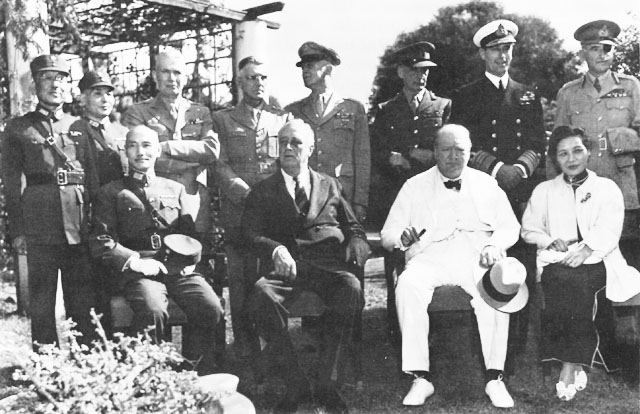
Chiang Kai-shek(China's former President), Franklin Delano Roosevelt, Winston Churchill, and Soong Mei-ling(China's former first lady) at the Cairo Conference


Growing out of the varied circumstances, exigencies, and necessities, a paternalistic outlook brought a missionary-conversion ethos together with a secular sense of national benevolence. Americans came to profess faith in a China developing along the path blazed by their notion. The U.S. attempted to remold China in their image strategically, scientifically, economically, and religiously by group lobbying for increased presence of traders, missionaries, doctors, diplomats, politicians, educators, and soldiers. Unlike the very beginning of the 21st century when most Chinese viewed all western countries as opposing powers to maintain China’s territorial, political, and cultural integrity,  the Chinese people under the guidance of their nominal leader, Chiang Kai-shek appeared willing and eager to adopt Protestant religion and democratic political ideology. Consequently, after 1931,Chiang’s popularly accepted image in the United States became one of a valiant, heroic Christian ready to lead his people into an American-style future. An economic angle to the relationship premised on enormously profitable trading connection, one guaranteed by China’s massive population.        


First Lady Madam Chiang Kaishek 1943 Speech to U.S. Congress


The most obvious presence of America’s paternalism towards China was America’s supporting the KMT during World War II and China’s Civil War. As the “father” who cultivated China following American steps, the United States offered KMT the material, training, financial, and political supports to guarantee the nominal ruling party which favored American values and ideology at that time could survive Japanese invasion and the risk of being overturning by the CCP in order to protect America’s interest. The United States feared the victory of the CCP could completely change the developing path in China and offset all America’s previous endeavors. U.S. actions and policy choices reinforced existing American proclivities to back Chiang Kai-shek’s Nationalists, who continued to enjoy broad political support in the United States.


We can easily identify that the Sino-American relations at this period of time was dominated by the United States following the pattern of paternalism. This is a top-bottom pattern which is largely decided by the power of the United States and China respectively at that time.